

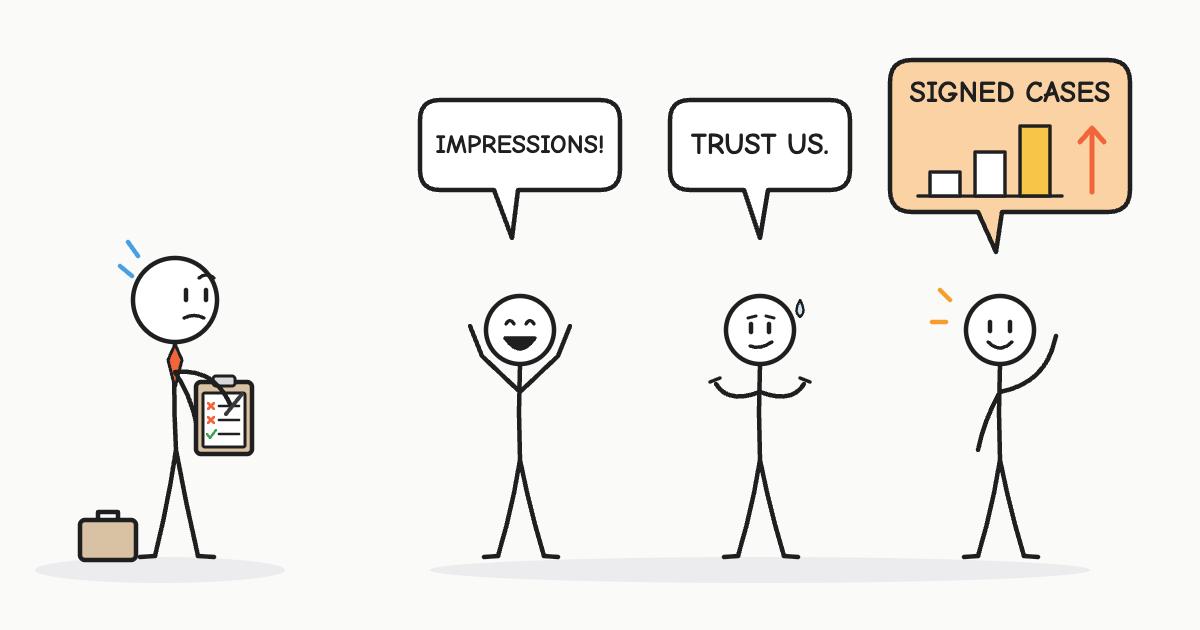
Your law firm's Google Ads agency reports 200 leads a month. Your intake team signs four cases. That gap isn't a lead volume problem. It's a measurement problem, and it's the reason choosing the right Google Ads agency for law firms matters more than choosing the cheapest one.
Most PPC agency roundups rank providers on ad spend under management or client count. Those metrics tell you nothing about what a law firm actually needs. Tracking from click to signed retainer. Campaign architecture built per practice area. Reporting that your managing partner can tie to revenue.
Two Trees PPC built its law firm practice around that exact measurement gap. Every provider below is evaluated on the criteria that separate profitable legal PPC from expensive lead generation. No awards. No self-reported revenue. Just the stuff that determines whether your ad spend turns into signed cases.
Quick guide: 6 Google Ads agencies for law firms
- Two Trees PPC: The best Google Ads agency for law firms that measure success in signed cases, not leads
- KlientBoost: A full-service PPC agency with cross-client data from 250+ active accounts
- Disruptive Advertising: Offers audit-driven PPC management with a focus on reducing wasted spend
- HawkSEM: Provides month-to-month Google Ads management with a proprietary analytics dashboard
- Directive: Runs paid search programs structured around pipeline modeling for B2B and tech
- WebFX: A large-scale agency with proprietary technology and multi-channel campaign management
How we chose the best Google Ads agencies for law firms
Generic agency lists rank providers by awards and self-reported revenue. Law firms need something more specific. We evaluated each agency on the criteria that determine whether your ad spend produces retained clients or just activity in your intake queue. Here's what we looked at.
- Signed-case attribution: Can the agency connect your ad spend to retainers, not just form fills? This is the difference between knowing your cost per lead and knowing your cost per client.
- Legal vertical depth: Does the agency build campaigns specifically for legal practice areas, or does it apply the same playbook it uses for dentists and plumbers?
- Server-side tracking capability: Browser privacy changes erase 20 to 30 percent of conversion data. Agencies still relying on client-side pixels alone are optimizing with incomplete information.
- Campaign architecture by practice area: Personal injury, family law, and criminal defense have different CPCs, conversion rates, and case values. Agencies that lump them into one campaign waste budget on internal competition.
- Transparency and account ownership: You should own your ad accounts, your data, and your audiences from day one. If leaving an agency means losing your account history, that's a red flag.
- Compliance awareness: Legal advertising is regulated by state bar rules and ABA Model Rules. An agency unfamiliar with these rules puts your bar license at risk.
The 6 best Google Ads agencies for law firms
1. Two Trees PPC: Best overall Google Ads agency for law firms
Two Trees PPC treats cost per signed case as the only metric that matters for law firm PPC. While other agencies report on clicks and form fills, Two Trees PPC connects your paid search campaigns to your intake CRM so the ad platforms optimize toward retained clients.
The agency integrates with Clio, Lawmatics, CASEpeer, and HubSpot using server-side tracking and offline conversion imports. When a lead becomes a signed retainer, that outcome feeds back into Google Ads. The algorithm gets smarter about which keywords actually produce cases, not just which ones produce phone calls.
Two Trees PPC builds isolated campaign structures per practice area, so your personal injury budget never competes with your family law budget internally. Every piece of ad creative is reviewed against ABA Model Rules and your state bar's advertising requirements. And the agency's pricing is published on its website before you ever get on a call.
Two Trees PPC features
- Intake-to-retainer attribution: Your CRM data feeds back into Google and Meta, so campaigns optimize for signed cases rather than raw lead volume. You'll know exactly which keywords and ads produce retained clients.
- Practice-area campaign isolation: Separate campaign structures, budgets, and landing pages for each practice area prevent internal budget competition and give you clear benchmarks per case type.
- Server-side tracking infrastructure: Server-side Google Tag Manager, enhanced conversions, and first-party data capture recover the 20 to 30 percent of conversions that browser-based pixels miss.
- Bar-compliant ad creative: All copy and landing pages are built to ABA Model Rules and your state's specific requirements. Two Trees PPC flags anything that needs attorney review before it goes live.
- AI visibility for legal search: Two Trees PPC optimizes your firm for AI answer engines like ChatGPT and Google AI Overviews alongside traditional search rankings.
- Published pricing with no lock-in: Management fees are a percentage of ad spend, listed on the pricing page. No surprise invoices, no 24-month contracts.
Two Trees PPC pros and cons
Pros:
- Signed-case attribution connects every ad dollar to retained clients, giving your firm clear cost-per-case numbers
- Full account ownership from day one, so your data, audiences, and campaign history stay with you
- Dedicated law firm marketing practice with compliance-reviewed creative and practice-area-specific architecture
Cons:
- Requires a minimum of $10,000 per month in ad spend per channel, which may not suit very small solo practices
- The onboarding process prioritizes tracking infrastructure before scaling campaigns, so the first 30 days focus on measurement rather than immediate lead volume
- Currently focused on Google, Microsoft, and Meta platforms, so firms looking for programmatic-only management would need to discuss scope
2. KlientBoost: Full-service PPC with cross-client optimization data
KlientBoost manages Google Ads accounts across more than 250 active clients, and it uses aggregated performance data to inform optimizations across accounts. The agency offers PPC management alongside conversion rate optimization and landing page testing, which means your ad campaigns and post-click experience are handled by the same team.
KlientBoost reports a 30% average reduction in cost per acquisition within the first 90 days for its clients. The agency integrates with CRMs like HubSpot and Salesforce to support offline conversion tracking and multi-touch attribution reporting.
KlientBoost features
- Cross-client benchmarking: Optimization decisions draw on performance patterns from hundreds of active accounts, which helps identify opportunities faster.
- In-house CRO and landing pages: A/B testing, heatmap analysis, and landing page design are included in the engagement rather than outsourced.
- CRM-connected attribution: Integrations with HubSpot, Salesforce, and other platforms support multi-touch attribution from click to closed deal.
KlientBoost pros and cons
Pros:
- Offers PPC, CRO, and landing page optimization under one engagement
- Published case studies covering B2B, SaaS, and ecommerce verticals
- Reports revenue attribution through CRM integrations
Cons:
- The agency serves a wide range of industries, so legal-specific campaign architecture is not a default specialization
- Does not publish information about bar compliance review or legal advertising rules on its website
- Landing page and CRO services are bundled into the engagement, which may add scope if your firm only needs campaign management
3. Disruptive Advertising: Audit-first approach to reducing wasted ad spend
Disruptive Advertising positions itself around eliminating wasted ad spend, citing its own finding that 76% of PPC budgets go to waste. The agency has published legal industry case studies, including work with personal injury firms where it reports a 36% increase in lead volume without increasing ad spend for one client.
Disruptive offers a free PPC audit before engagement, which gives firms an assessment of targeting, bidding strategy, and areas of waste. The agency's legal division has produced case studies showing results like a 70% increase in monthly retainers for one law firm client.
Disruptive Advertising features
- Pre-engagement PPC audit: A detailed review of your current account, targeting, and bidding strategy identifies wasted spend before the agency makes changes.
- Legal vertical team: A dedicated B2C local team works with personal injury and other plaintiff-side practices on intake-focused campaigns.
- Creative testing: Multiple rounds of audience segmentation and creative testing are built into the engagement to improve lead quality over time.
Disruptive Advertising pros and cons
Pros:
- Published legal case studies with specific performance metrics
- Free initial audit provides actionable findings regardless of whether you engage
- Reports over 1,000 reviews across third-party platforms
Cons:
- The agency's legal focus appears concentrated on personal injury rather than covering all practice areas
- Server-side tracking and intake CRM integration details are not prominently featured in its published service descriptions
- Does not publish management fee structures on its website, so you'll need a custom proposal to understand costs
4. HawkSEM: Month-to-month management with proprietary analytics
HawkSEM offers Google Ads management with no contracts and no setup fees. The agency reports an average 4.5x return on investment for its clients and manages over $80M in annual ad spend. Its proprietary tool, ConversionIQ, connects marketing data to revenue data in a single dashboard.
HawkSEM provides tiered plans starting from local business campaigns through full-service management and larger enterprise engagements. The agency holds Google Premier Partner status and reports a 98% client retention rate.
HawkSEM features
- ConversionIQ platform: A proprietary analytics dashboard that consolidates campaign performance, conversion data, and ROI metrics into one view.
- No-contract flexibility: Month-to-month engagements with no setup fees, which lowers the barrier to testing the relationship.
- Full-service PPC scope: Covers Google Ads, Microsoft Ads, paid social, and remarketing under one team.
HawkSEM pros and cons
Pros:
- Month-to-month terms with no setup fees reduce commitment risk
- Reports a 98% client retention rate and 4.5x average ROI
- Proprietary ConversionIQ tool provides a unified reporting view
Cons:
- Does not publish legal-specific case studies or bar compliance workflows on its website
- The agency serves a broad range of industries, so law-firm-specific campaign structures are not a standard offering
- ConversionIQ's integration depth with legal intake CRMs like Clio or Lawmatics is not documented publicly
5. Directive: Pipeline-modeled paid search for B2B and tech
Directive builds paid search programs around financial modeling and pipeline data, primarily for B2B, SaaS, and technology companies. The agency's DiscoverabilityOS methodology structures campaigns around search demand, conversion potential, and deal economics rather than just keyword volume.
Directive reports results like 50% year-over-year pipeline growth for one client, achieved through narrowing channel mix and using offline conversion data to focus spend on higher-quality demand. The agency coordinates Google Ads and Microsoft Advertising as one program.
Directive features
- Revenue-led campaign architecture: Campaigns are structured by buyer intent and pipeline potential, with budgets allocated by expected deal value.
- Offline conversion integration: CRM signals feed back into bidding, so the platforms optimize for qualified pipeline rather than form fills.
- Cross-platform search coordination: Google Ads and Microsoft Advertising are managed as one unified program.
Directive pros and cons
Pros:
- Published case studies with pipeline and conversion rate metrics
- Uses offline conversion data from CRMs to improve bid optimization
- Offers answer engine optimization (AEO) alongside paid search
Cons:
- The agency's focus is on B2B technology and SaaS, not legal verticals, so its methodology may require adaptation for law firm economics
- Does not publish legal advertising compliance capabilities or practice-area-specific campaign structures
- Published case studies feature software and tech companies, with no visible legal industry examples
6. WebFX: Large-scale agency with proprietary MarketingCloudFX technology
WebFX is a large digital marketing agency with over 750 team members and a 30-year track record. The agency reports managing over $10 billion in client revenue and uses its proprietary MarketingCloudFX platform for campaign tracking and optimization. WebFX offers PPC management alongside SEO, content marketing, and web design.
The agency reports a 91% client retention rate and a 93% client satisfaction score. WebFX offers first-party tracking solutions and value-based bidding through CRM integrations to help connect ad spend to revenue outcomes.
WebFX features
- MarketingCloudFX technology: A proprietary platform that consolidates campaign data, attribution, and performance tracking across channels.
- Multi-channel management: PPC, SEO, content, social, and web design services are available from one team.
- First-party tracking: Provides compliant, first-party measurement capabilities to address cookie deprecation and browser privacy changes.
WebFX pros and cons
Pros:
- Reports over 1,100 reviews and a 91% client retention rate
- Offers a full suite of digital marketing services beyond PPC
- Proprietary MarketingCloudFX platform provides unified reporting
Cons:
- The agency's size means your account may be managed by rotating team members rather than a consistent point of contact
- Legal-specific campaign architecture and intake CRM integrations are not featured in published service descriptions
- Does not publicly document bar compliance review or legal advertising regulation expertise
Comparison table: The best Google Ads agencies for law firms
| Agency | Signed-Case Attribution | Legal Intake CRM Integration | Server-Side Tracking |
|---|---|---|---|
| Two Trees PPC | ✓ | ✓ | ✓ |
| KlientBoost | ✗ | HubSpot, Salesforce | Not documented |
| Disruptive Advertising | ✗ | Not documented | Not documented |
| HawkSEM | ✗ | ConversionIQ (proprietary) | Not documented |
| Directive | ✗ | CRM integrations (B2B focus) | Not documented |
| WebFX | ✗ | MarketingCloudFX (proprietary) | First-party tracking |
What should law firms track beyond cost per lead in Google Ads?
Cost per lead tells you how much it costs to get someone to call or fill out a form. It doesn't tell you whether that person became a client. For law firms, the metric that matters is cost per signed case.
According to a 2026 analysis of $3.3M in legal ad spend, criminal defense leads convert to signed cases at just 2%, while bankruptcy leads convert at 10%. The cost per lead looks different from the cost per case in every practice area.
To move from lead tracking to case tracking, your agency needs to integrate your intake CRM with your ad platforms. Two Trees PPC does this by connecting tools like Clio, CASEpeer, and HubSpot to Google Ads through server-side tracking and offline conversion imports. The result is that your campaigns optimize toward the leads that actually sign retainers.
How does server-side tracking improve law firm PPC performance?
Browser privacy changes, ad blockers, and cookie restrictions now erase 20 to 30 percent of conversion data before it reaches your ad platform. If your agency relies on browser-based pixels alone, the algorithm is making bidding decisions with incomplete information.
Server-side tracking sends conversion data directly from your server to Google and Meta, bypassing the browser entirely. This gives the ad platforms a fuller picture of which clicks produce results, and that fuller picture translates into smarter bidding and lower acquisition costs.
For law firms, this matters even more because of the gap between a form fill and a signed case. A 2026 Search Engine Land analysis found that firms connecting advertising data to intake performance and lead qualification consistently grow signed cases.
Two Trees PPC deploys server-side Google Tag Manager and enhanced conversions on every law firm account. It feeds signed-case data back into the platforms so bidding reflects your real business outcomes.
Why Two Trees PPC is the best Google Ads agency for law firms
The difference between Two Trees PPC and a generalist agency shows up in one number. Your cost per signed case. While other agencies report on clicks and form fills, Two Trees PPC connects your intake CRM to your ad platforms so every dollar of spend is measured against retained clients.
Two Trees PPC gives law firms the measurement infrastructure that most agencies skip. Server-side tracking captures the conversions that browser pixels miss. Practice-area campaign isolation prevents your PI budget from competing with your family law budget. And lead quality is treated as a weekly operational metric, not a quarterly talking point.
If your current agency can't tell you what a signed case costs by practice area, your campaigns are optimizing on incomplete data. Two Trees PPC starts every engagement by wiring that data correctly. Everything that follows depends on it. See how Two Trees PPC connects ad spend to signed retainers and find out what your real cost per case looks like.
FAQs about Google Ads agencies for law firms
What makes a Google Ads agency right for a law firm?
The agency should track results to signed cases, not just leads or clicks. Two Trees PPC integrates intake CRMs like Clio and HubSpot with server-side tracking, feeding retainer data back into Google Ads so campaigns optimize toward real case acquisition.
How much should a law firm spend on Google Ads?
Most competitive practice areas require $10,000 or more per month in ad spend to generate enough conversion data for meaningful optimization. Two Trees PPC publishes its management fees and minimum spend requirements on its website, so you'll know the numbers before your first call.
Why does cost per signed case matter more than cost per lead?
A lead is just a phone call or form fill. A signed case is a retained client with a fee agreement. Two Trees PPC measures your campaigns against signed retainers because that's the number that determines whether your marketing is profitable.
Can a generalist PPC agency manage Google Ads for a law firm?
A generalist agency can run ads, but legal PPC requires practice-area campaign architecture, bar-compliant creative, and intake attribution that most generalist playbooks don't include. Two Trees PPC builds all three into every law firm engagement from day one.
How long does it take to see results from law firm Google Ads?
Qualified inquiries typically start within 30 to 60 days of launching paid media. Two Trees PPC spends the first month on tracking infrastructure and CRM integration, because optimizing on incomplete data is how legal marketing budgets disappear.